(To download a PDF of the Policy Update, please visit our publication library.)
Read the latest policy update from Neil Simpson, CWSF/WFLC Director of Policy. This month’s policy update covers:
- 2026 Interior Appropriations Signed into Law
- Secretary of the Interior Signs Order Creating the U.S. Wildland Fire Service
- Senate Passes the Disaster Assistance Simplification Act
- Grazing for Wildfire Risk Reduction Act Passes Committee
- Bill Introduced to Provide Relief to Logging Businesses Impacted by Market Disruptions
2026 Interior Appropriations Signed into Law
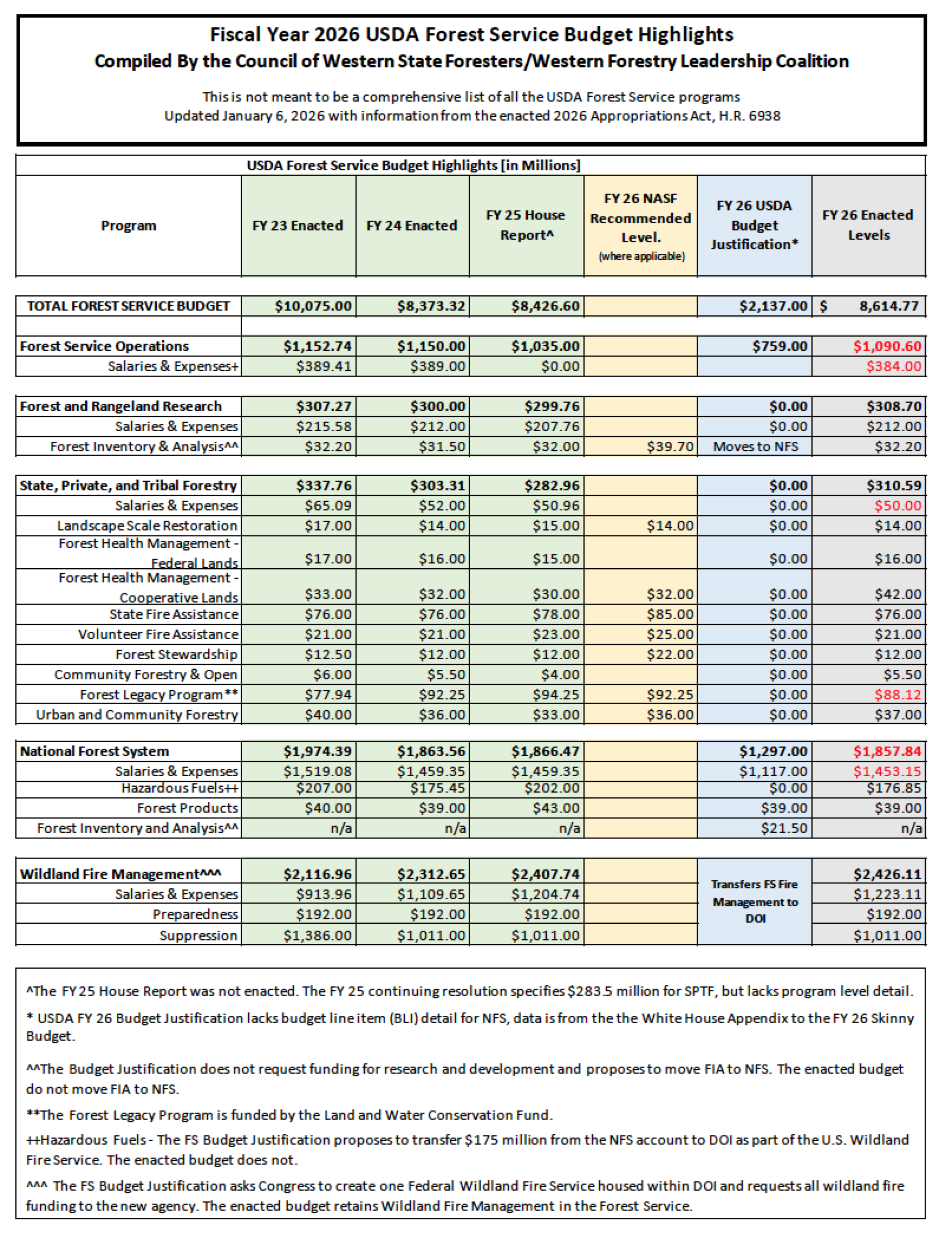
President Trump has signed into law H.R. 6938, the Commerce, Justice, Science; Energy and Water Development; and Interior and Environment Appropriations Act, 2026. The bill funds the USDA Forest Service (Forest Service) at $8.6 billion. The budget is generally in line with previous levels, with some minor increases at the budget line item (BLI) level. It funds the U.S. Department of the Interior (DOI) Wildland Fire Management programs at $1.147 billion, which is an increase of $33.7 million.
View the table below for specific budget line items or download a PDF.
In addition to appropriating funds for fiscal year 2026 (FY 26), the bill addresses several other budget-related policies.
Limits the Executive Branch’s Ability to Move Funding
Section 443 of the bill seeks to limit the executive branch’s ability to alter the congressionally appropriated funding levels by stating “amounts provided in this Act shall be allocated in the amounts specified for the programs, projects, and activities specified in the tables in the explanatory statement.”
However, the program funding tables on pages 56-58 of the Joint Explanatory Statement do not correspond one-to-one with all Forest Service BLIs in the appropriations tables on pages 161-165. For example, they include Forest Health Program funding for spruce budworm and sudden oak death, which are a part of the Forest Health Management BLI. Also, State Fire Assistance and Volunteer Fire Assistance are merged into a line titled Cooperative Fire Assistance. Most notably, Forest Stewardship and Landscape Scale Restoration, which are funded at $12 million and $14 million, respectively, are omitted from the program funding tables.
Directs the Forest Service to Maintain Adequate Staffing
Congress included administrative provisions directing the Forest Service to maintain adequate staffing levels by including language stating:
“The Forest Service shall maintain staffing levels in order to fulfill the mission required under title 7, title 16 [Forest Service], title 30, title 43, and title 54, United States Code, including to protect natural and cultural resources, provide and maintain appropriate access and recreation for visitors, provide safety precautions for visitors and staff, maintain physical and natural infrastructure, provide information and respond to stakeholders and the general public, conduct tribal consultation, provide for administrative support, administer forestry assistance programs, provide technical assistance to states, tribes and private landowners, manage energy and minerals resources, and carry out other activities in support of effectively operating the National Forest System and carrying out programs administered by the Forest Service in a timely manner.”
Does Not Unify DOI and Forest Service Wildland Fire Budgets
As in years past, the DOI Wildland Fire Management budget is appropriated as a “Department-Wide Program.” However, it does not include BLIs for the newly created U.S. Wildland Fire Service (USWFS), nor does it consolidate Forest Service and DOI wildland fire budgets, as requested in the President’s budget proposal.
Additionally, it directs “the Secretary of Agriculture, in consultation with the Secretary of the Interior, to contract with an independent, non-partisan research organization with expertise in federal land management to conduct a comprehensive study on the feasibility of consolidating wildland fire management operations as proposed in the President’s budget. The Committees expect the study to assess the impacts a consolidation would have on reaching proposed timber targets, continued cohesion between wildland fire management and the hazardous fuels reduction program, continued use of the available red card-certified workforce, and how a new consolidated service would differ from the role the National Interagency Fire Center (NIFC) already plays in coordinating fire response. The study should analyze the impact a consolidation would have on states, localities, and Tribes.”
Secretary of the Interior Signs Order Creating the U.S. Wildland Fire Service
On January 12, 2026, Secretary of the Interior Doug Burgum signed Secretarial Order No. 3448. The order formally establishes the USWFS within the Office of the Secretary. It declares that the Director of the USWFS will report to the Secretary and “be responsible for all aspects of the Department’s wildland fire actions and activities.” Additionally, the order outlines that the Director of the Office of Wildland Fire, the Director of the Office of Aviation Services, and the leader of each Bureau’s wildland fire program are “hereby realigned and will report to the Director,” and additional fire personnel will realign as soon as practicable.
In a press release, the DOI announced that Chief Brian Fennessy will lead the creation of the USWFS.
Senate Passes the Disaster Assistance Simplification Act
The Senate has passed S. 861, the Disaster Assistance Simplification Act. The bill is sponsored by Senator Gary Peters (D-MI), the Ranking Member of the Committee on Homeland Security and Government Affairs, and co-sponsored by the Chairman of the Committee, Senator Rand Paul (R-KY), along with four others.
The bill would require the Federal Emergency Management Agency (FEMA) to establish a universal application process for disaster survivors. According to a press release from Senator Peters' office, the legislation would streamline what is currently a “daunting process” with “complicated paperwork.”
The bill is now being held at the desk in the House of Representatives, which could allow it to bypass Committee assignments and move directly to the floor for consideration.
Grazing for Wildfire Risk Reduction Act Passes Committee
H.R. 1110, the Grazing for Wildfire Risk Reduction Act, has passed the House Committee on Natural Resources.
The bill, sponsored by the late Congressman Doug LaMalfa (R-CA), would require the Chief of the Forest Service to increase opportunities to utilize livestock grazing as a wildfire risk reduction strategy. According to the legislation, strategies would include grazing on vacant allotments during times of drought, wildfire, or other natural disasters; targeted grazing; and the use of temporary grazing permits.
The bill is also included in section 117 of the Fix Our Forests Act.
Bill Introduced to Provide Relief to Logging Businesses Impacted by Market Disruptions
Congressman Rick W. Allen (R-GA) has introduced H.R. 7195, the Timber Harvesters, Haulers and Landowners Market Disruptions Relief Act.
The bill would establish a process under which the Secretary of Agriculture may declare a market disruption and a program within the USDA to provide financial assistance to forest products harvesting and hauling businesses and landowners that have suffered revenue losses from market disruptions. The bill would appropriate funds “equal to the total amount collected in anti-dumping and countervailing duties” from softwood lumber imported from Canada.
The bill has no co-sponsors and has been referred to the House Committee on Agriculture.