(To download a PDF of the Policy Update, please visit our publication library.)
Read the latest policy update from Neil Simpson, CWSF/WFLC Director of Policy. This month’s policy update covers:
- Presidential Determination Exempts Fire Retardant from Water Pollution Standard
- U.S. Department of the Interior Releases Strategic Plan for 2026-2030
- Bureau of Land Management Proposes to Update Public Land Planning Rule
- Aquatic Restoration and Conservation Act Introduced
- Wildfire Emergency Act of 2026 Introduced
- Legislation Introduced to Ban Betting on Wildfires
- Legislation Introduced to Connect Forest Stewardship with Business Incentives
- Fiscal Year 2027 Appropriations Update
Presidential Determination Exempts Fire Retardant from Water Pollution Standards
On November 10, 2026, President Trump issued a Presidential Memorandum to the Secretary of the Interior, the Secretary of Agriculture, and the Administrator of the Environmental Protection Agency (EPA). The memorandum exempts firefighting activities, including aerial retardant use, performed by federal agencies and their contractors from “Federal, State, interstate, and local requirements, administrative authority, and process and sanctions respecting the control and abatement of water pollution.”
The exemption expires on November 10, 2027.
View the Fact Sheet and Presidential Memorandum.
U.S. Department of the Interior Releases Strategic Plan for 2026-2030
The U.S. Department of the Interior (DOI) has released a strategic plan to guide the Department until 2030. The plan outlines four primary goals:
- Expand American Prosperity
- Keep Communities Safe, Beautiful and Resilient, and Expand Access to the Outdoors
- Promote the Enjoyment and Conservation of Our Lands, Waters, Natural Resources and Cultural Heritage
- Productively Collaborate and Coordinate with States, Tribes, Communities and People
View this plan, and past plans, on the DOI’s strategic planning webpage.
Bureau of Land Management Proposes to Update Public Land Planning Rule
The Bureau of Land Management (BLM) is proposing to update its land use planning regulations. According to a November 5, 2026 press release, the changes will “cut red tape, improve coordination with state and local governments and speed up decision-making for public lands.” The BLM first adopted its land use planning regulations in 1979 with only two updates since then.
The proposed rule is published in the Federal Register and has a 60-day comment period. Written comments may be submitted through regulations.gov by searching “RIN 1004-AF53” and following the instructions.
The BLM will host a virtual public information session on Dec. 3, beginning at 5 p.m. MT. To attend the webinar, you must register at Webinar: Revision of Regulations for Planning, Programming, Budgeting.
Aquatic Restoration and Conservation Act Introduced
On October 26, 2026, Representative Joe Neguse (D-CO) introduced H.R. 10916, the Aquatic Restoration and Conservation Act.
The bill would require the Secretaries of Agriculture and the Interior to develop a strategy to increase the use of aquatic restoration and conservation activities in wildfire risk mitigation and post-fire recovery efforts on federal lands. It defines aquatic restoration as “any activity resulting in the protection or enhancement of wet meadows, stream or river corridors, floodplains, riparian areas, or wetlands for the purpose of mitigating wildfire risk, improving post-fire recovery, or improving watershed health.”
The Secretaries may enter into agreements with the National Park Foundation, National Fish and Wildlife Foundation, National Forest Foundation, and the Foundation for America’s Public Lands to develop the strategy which shall:
- Consider the best available science, identify gaps in the science, and include a plan to address such gaps.
- Assess the workforce training and development capacity of DOI and USDA and incorporate that capacity into the strategy.
- Identify opportunities to use aquatic restoration to increase the effectiveness of wildfire mitigation and post-fire recovery efforts.
- Incorporate relevant federal, state, local, and tribal planning documents.
The bill is co-sponsored by Representative Brittany Pettersen (D-CO) and has been referred to the House Natural Resources Committee and the House Agriculture Committee.
Wildfire Emergency Act of 2026 Introduced
On October 26, 2026, Representative Jimmy Panetta (D-CA) introduced H.R. 10917, the Wildfire Emergency Act of 2026. The purpose of the multifaceted bill is to increase forest restoration on National Forest System lands and wildfire resilience of communities.
To increase the pace and scale of management on NFS lands, the bill would:
- Establish a pilot program for the USDA to enter into conservation finance agreements.
- Encourage project planning and analysis at a landscape scale of 100,000 acres or more.
- Support projects that emphasize the reintroduction of fire, restoring ecological integrity, reducing wildfire risk, and improving forest resiliency.
- Require “ecological standards and collaboration for landscape scale projects.”
- Coordinate with Federal, State, local, and tribal entities to support the conservation finance pilot program.
- Create a new grant program and authorize up to $50 million in appropriations for fiscal years (FY) 2027-2031 for forest collaborative groups to engage in planning, implementation, and monitoring.
The bill also creates several new programs for community wildfire resilience that would:
- Authorize up to $100,000,000 to be appropriated for a new program that would improve energy resilience and power needs for critical infrastructure such as hospitals and communication facilities.
- Direct the Secretaries to “expedite the placement of wildfire detection equipment” and “expand the use of satellite and remote sensing data and mobile technologies.”
- Amend the Energy Conservation and Production Act to require the use of fire-resistant materials for participants in the Department of Energy’s Weatherization Assistance Program.
The bill also seeks to increase USDA and DOI’s workforce development programs. It would require the Secretaries to establish at least one prescribed fire training center and create a grant program to assist in workforce recruitment and development and expand public awareness of forestry and fire management.
The bill has no co-sponsors and has been referred to four committees: Agriculture, Natural Resources, Energy and Commerce, and Education and Workforce.
Legislation Introduced to Ban Betting on Wildfires
On October 29, 2026, Representative George Whitesides (D-CA) introduced H.R. 10951, the No Bets on Wildfires Act. The bill would “amend the Commodity Exchange Act to prohibit the listing of contracts related to wildfires,” effectively banning betting on wildfire outcomes in prediction markets.
The bill is co-sponsored by Representative James Gallagher, Vince Fong (both R-CA), and Andrea Salinas (D-OR). It has been referred to the House Agriculture Committee.
H.R. 10109, the Wildfire Event Contract Prohibition Act, introduced by Representative Michael Baumgartner (R-WA), would also ban betting on wildfire outcomes. It has no co-sponsors and has been referred to the House Agriculture and House Judiciary Committees.
Legislation Introduced to Connect Forest Stewardship with Business Incentives
Congressman Baumgartner (R-WA) has introduced H.R. 10952, the Health Forests Incentives Act of 2026. The bill aims to connect forest stewardship with targeted incentives for businesses that utilize wood from forest health and fuels reduction projects.
The bill would:
- Establish Fireshed Management areas comprised of areas identified as high risk in the wildfire crisis strategy and require the Secretaries of Agriculture and Interior to perform hazardous fuels reduction in those firesheds.
- Provide tax incentives for construction of facilities that use biomass to produce electricity.
- Make changes to the Wood Innovation Grant Program, including reducing the required match from 100% to 50% of the federal grant amount.
- Changes the name of the Community Wood Energy and Wood Innovation Grant Program to the Community Wood Facilities Program and raises the maximum available grant under the program from $1 million to $5 million.
In a press release, Baumgartner stated, “By connecting long-term stewardship in high-risk areas with incentives for businesses that use the wood we remove, this bill makes prevention a sustained economic activity—not just a series of isolated federal projects.”
The bill has no co-sponsors. It has been referred to the Agriculture Committee, Ways and Means Committee, and Natural Resources Committee in the House of Representatives.
Fiscal Year 2027 Appropriations Update
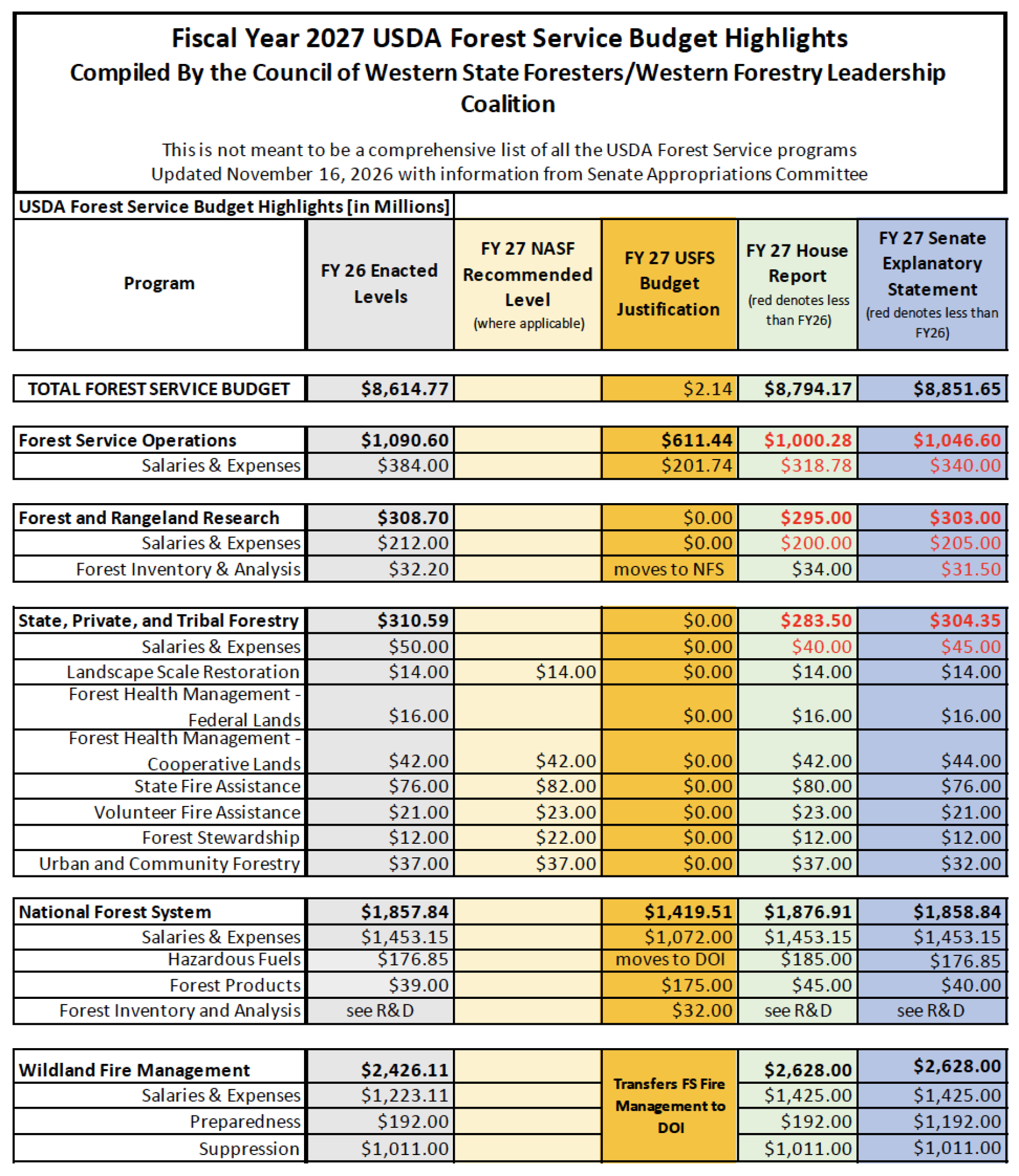
The House passed H.R. 9171, the Department of the Interior, Environment, and Related Agencies Appropriations Act, 2027, in June, and the Senate Appropriations Committee has published draft bill text, a summary, and the explanatory statement on the committee website.
Both bills would provide increases to the overall USDA Forest Service (Forest Service) budget when compared to FY 26 enacted levels. Increases would come in the National Forest System and Wildland Fire Budgets, with decreases in State, Private, and Tribal Forestry, Forest and Rangeland Research, and Forest Service Operations. Neither bill eliminates Forest and Rangeland Research or State, Private, and Tribal Forestry as proposed in the Forest Service Budget Justification. Nor does either bill include the proposal to transfer the Forest Service’s Wildland Fire Budget to the DOI Wildland Fire Service.
View the table below for specific budget line items or download a PDF.
In addition to appropriating funds, the bills address several other budget-related policies, including the following statements from the Senate draft.
- "The Committee supports the current structure consisting of the five regional research stations, the International Institute of Tropical Forestry, Institute for Pacific Islands Forestry, and the Forest Products Laboratory, and directs that each of the existing facilities and programs be funded at least at the fiscal year 2026 enacted level."
- "The Forest Service is reminded that the amounts designated within this appropriation are incorporated by reference for the grant programs as specified and is directed to fully disburse these funds as intended."
The House Report states the House Committee on Appropriations:
- “Recognizes that shared stewardship agreements are effective tools for the Forest Service and states to support forest and watershed improvements, reduce wildfire risk, and support rural communities.”
- “Encourages the Forest Service to continue engagement with States and Tribes on GNA projects wherever applicable, especially in areas with high risk of fire.”
- “Strongly supports the reauthorization of the Wildland Fire Fix and recognizes the importance of this to ensuring the continuity of suppression operations.”
The Senate now needs to formally mark up the bill and bring it to the floor, where it needs 60 votes to pass. Then the Senate and House versions need to be reconciled in order to become law. Some news outlets report that it is possible for Congress to accomplish this before the continuing resolution ends on December 11. However, incoming appropriations chair Patty Murray (D-WA) stated in an interview with Politico that “voters handed us a huge mandate to write these bills that reflect their priorities … the best way for us to do that is to do a short-term CR and then write these funding bills for next year,” so it remains to be seen if FY 27 appropriations will be enacted this year or when the next Congress arrives in Washington, D.C.